Textbooks
Two textbooks written for courses taught at USC. Each one comes with lecture slides, lab guides, and code on its course website.
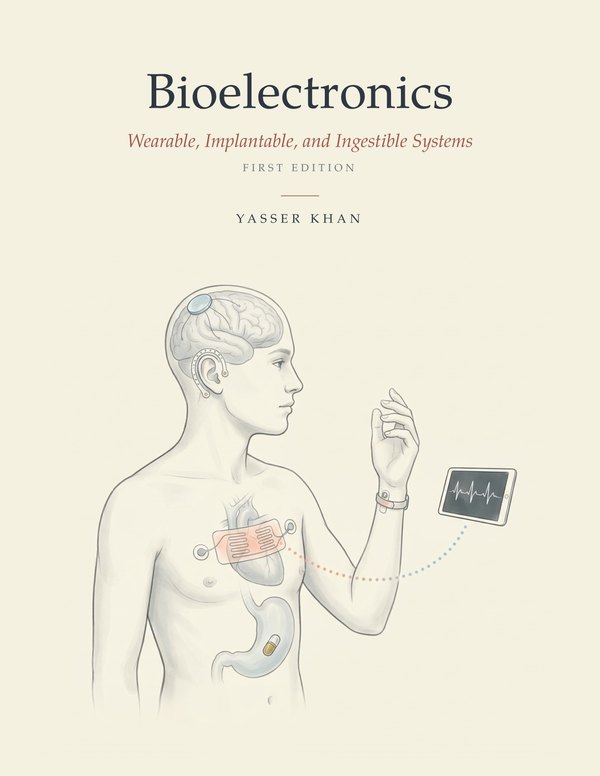
Bioelectronics: Wearable, Implantable, and Ingestible Systems
Yasser Khan. First edition, 2026.
ISBN-13: 979-8-9826941-0-2
Bioelectronic devices sit where electronics was never meant to go: on skin that stretches and sweats, inside tissue that attacks anything foreign, or in a stomach full of acid. This book explains how they are designed. It takes a sensing capsule, a wireless ECG patch, and a brain implant apart into the same blocks (body interface, sensor, front end, converter, processor, radio, power, and package) and then teaches each block in turn. Written for Bioelectronics, a graduate course at USC, it assumes no biology and no circuits beyond Ohm's law, so students from electrical engineering and from the life sciences can start together.
- Fourteen chapters, from cells and neurons to sensors, neural interfaces, soft materials, printing, power, and the path to patients
- Four labs that build one device layer by layer: a circuit board, printed electrodes, an analog front end, and firmware with a Bluetooth link
- Worked examples and problems in every chapter, with answers
- Color illustrations throughout
Download the PDF (bioelectronics-textbook-v1)
Slides, lab guides, and code: bioelectron.org
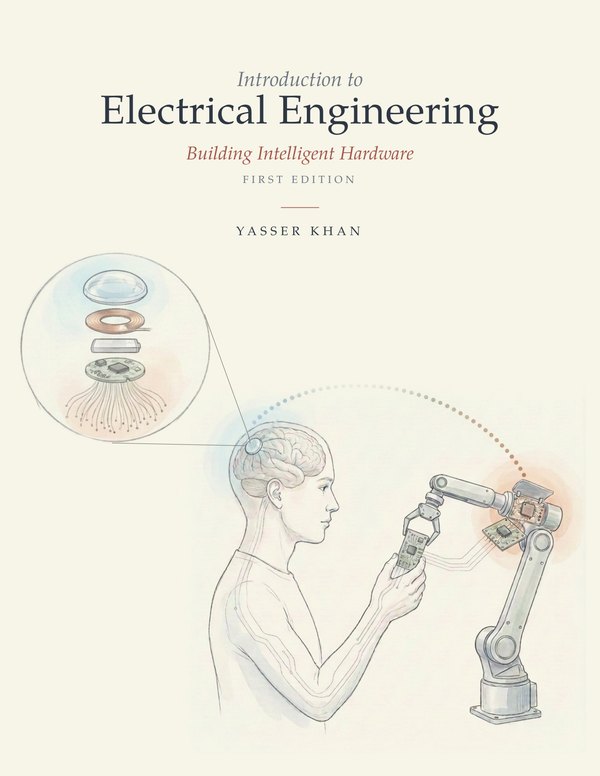
Introduction to Electrical Engineering: Building Intelligent Hardware
Yasser Khan. First edition, 2026.
A watch measures a pulse with light, a car watches the lane with a camera, and an implant the size of a coin listens to neurons and turns their activity into the motion of a cursor. These devices sense the physical world, decide something about it on the spot, and communicate the result. Written for EE 105 at USC, this book takes a first-year student from a brain-computer interface taken apart into its blocks, through circuits, semiconductor devices, sensors, machine learning on a microcontroller, and optical communication, to a final project of the student's own design.
- Ten laboratory sections, each a complete lab manual, built around the EE 105 demonstration board and the Arduino Nano 33 BLE Sense
- Worked examples, chapter summaries, and more than 200 problems with answers
- A Python lab kit with a simulated board for practice away from the bench
- Color illustrations throughout
Download the PDF (intro-to-ee-textbook-v1)
Course materials and lab software: ee105.org